Eliminating Burned-On Sand in Cylinder Heads
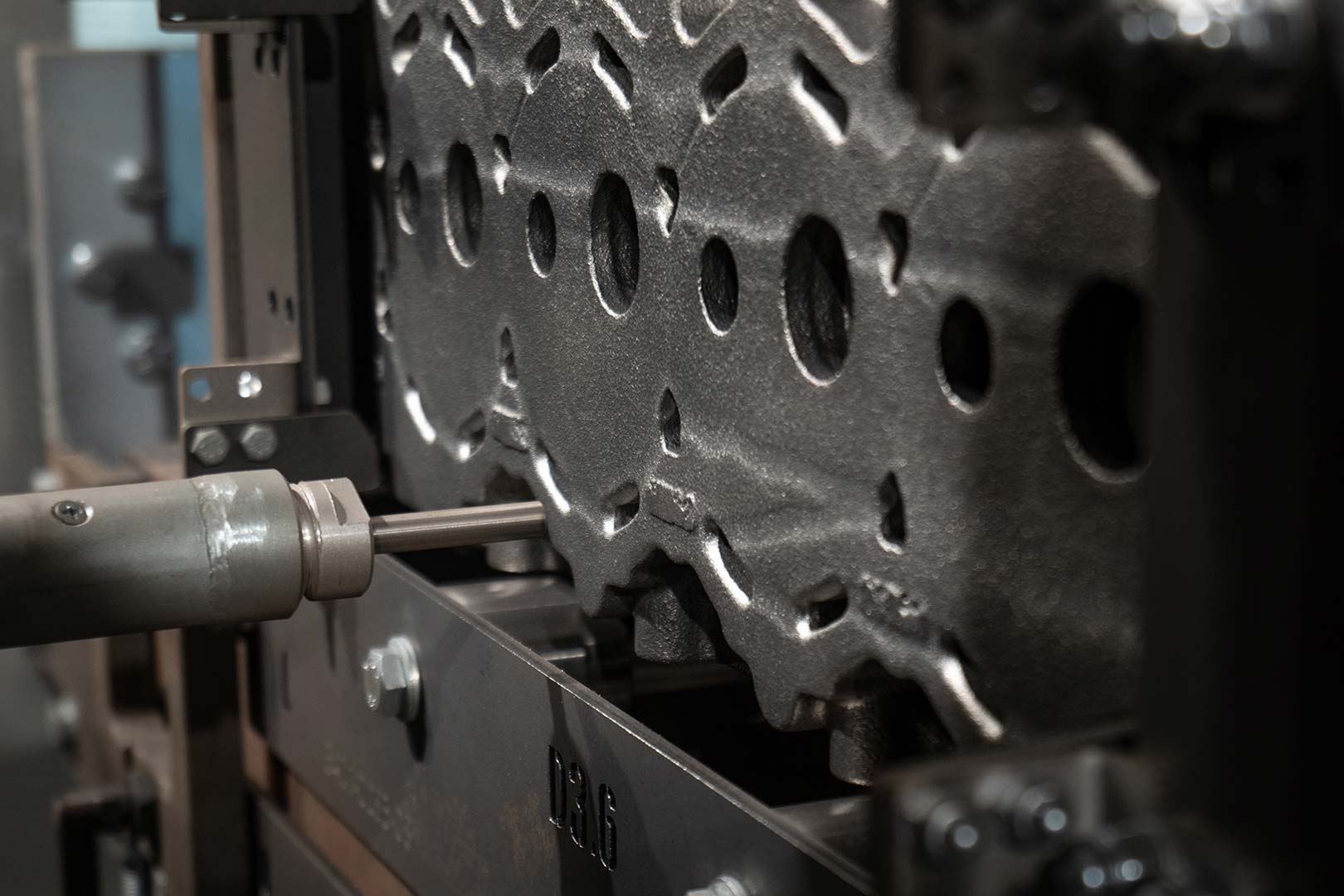
Stubborn Sand in Complex Engine Heads
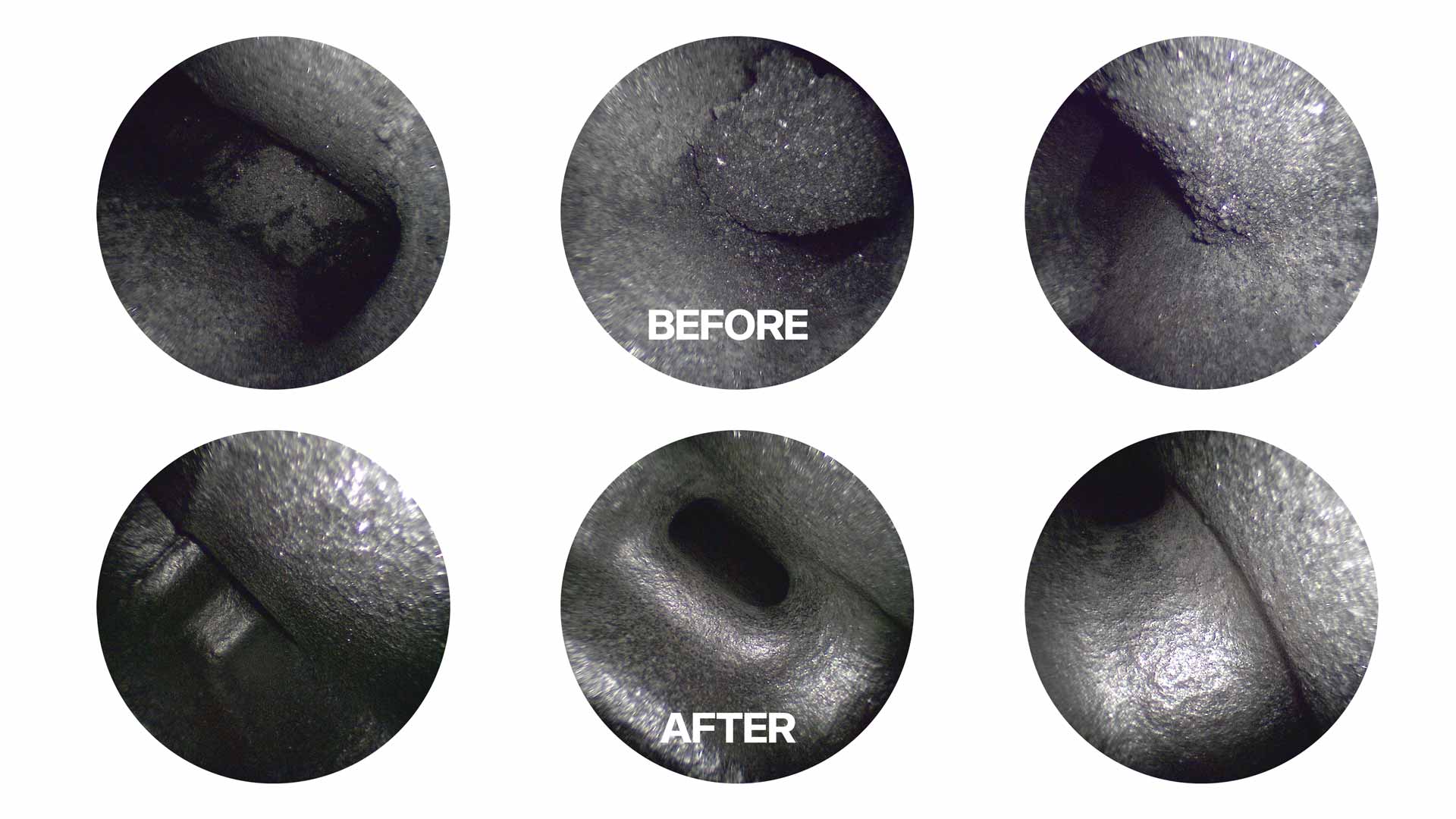
Imagine spending countless hours manually cleaning engine cylinder heads, scrubbing and sandblasting intricate channels by hand, only to find stubborn burned-on casting sand still lodged inside. It’s a frustrating reality for many foundries and engine manufacturers. Cylinder heads (and engine blocks) contain complex internal passages for oil and coolant, which often retain residual casting sand and scale after the metal casting or external blasting process. Manual cleaning of these passages is slow, inconsistent, and hazardous. Operators face clouds of abrasive dust and risk missing spots, leading to uneven results. This is why traditional manual sandblasting of internal passages is unreliable, costly in labor, and poses health risks to workers.
Manufacturers have learned the hard way that inadequate cleaning can have serious consequences. The goal is to remove all traces of sand and debris consistently, without subjecting workers to drudgery or danger. This is the problem that our innovative solution was designed to solve.
Robotic Internal Sandblasting
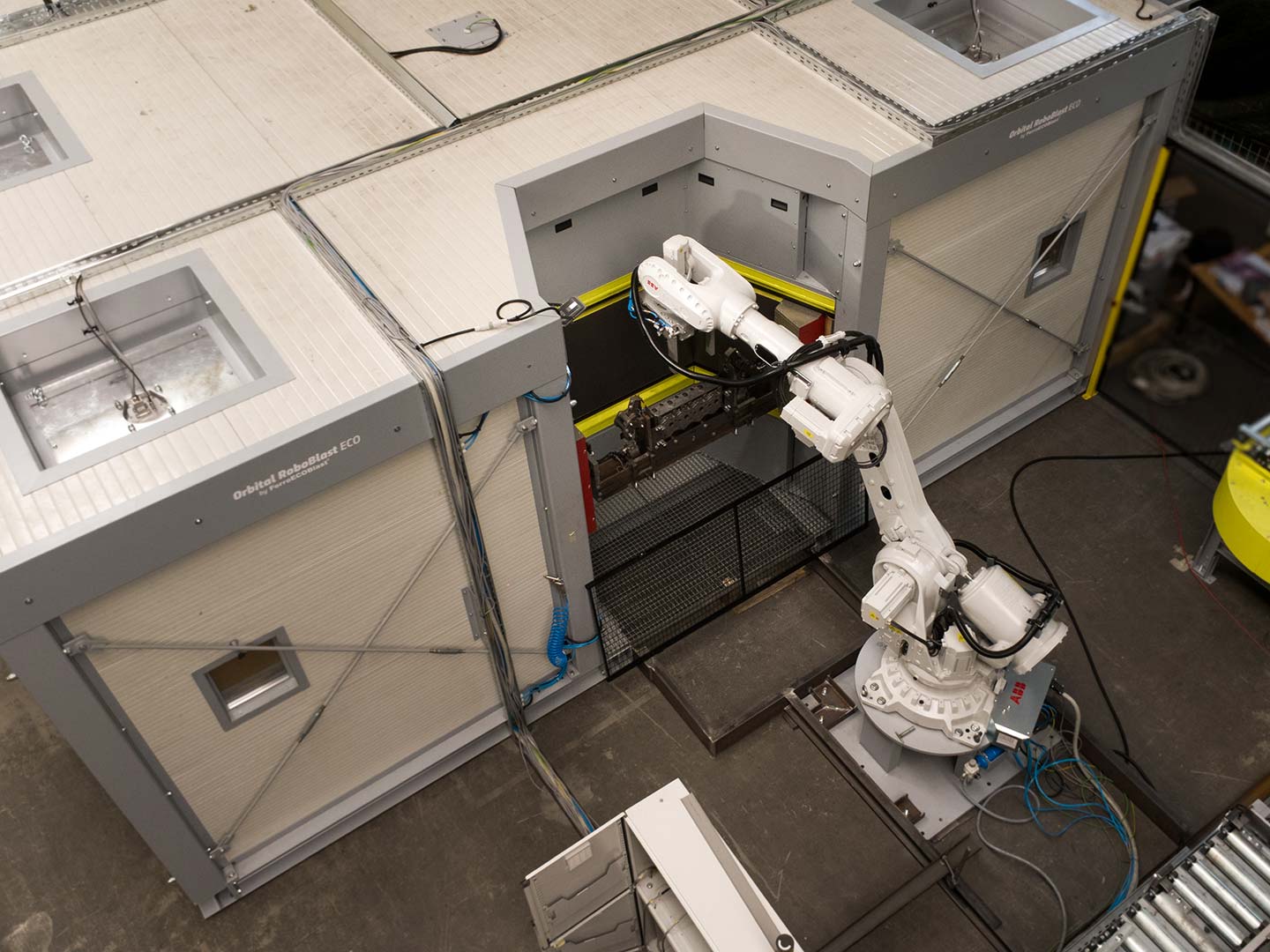
To overcome this challenge, we developed an automated internal sandblasting system that clears internal channels of cylinder heads after casting. Instead of manual labor, this solution uses advanced robotics and an enclosed blasting cabinet to do the hard work. The machine Orbital Roboblast is just one of the example solution how we dealt with this problem. It targets the burned-in sand and scale inside the tortuous oil and cooling channels that manual methods struggle with, delivering consistent, repeatable cleaning results on every part. The Orbital Roboblast ECO system is a fully automated internal blasting machine for engine heads and blocks, featuring multiple robotic arms and a rotating worktable to ensure every passage is thoroughly cleaned.
Unlike conventional sandblasting cabinets, this system operates in a programmed automatic mode. Once the cleaning recipe for a given part is selected, the machine runs the entire blast cycle without human intervention. Its heavy-duty blasting enclosure houses a rotating indexing table and multiple 6-axis robotic nozzles that precisely blast away sand from every internal surface. The machine’s robust construction and advanced media recovery system allow it to maintain consistent blasting performance and throughput for high production volumes. In short, it’s a turn-key solution that transforms a messy, manual process into a clean, controlled, and efficient automated operation.
How the Automated Blasting Process Works
Let’s walk through how a cylinder head is processed automatically, station by station. The Orbital Roboblast ECO uses an eight-station rotary indexing table (orbital feeder) that carries cylinder heads through a series of cleaning stages without pause. Here’s how the fully automated cycle works:
1. Loading & Positioning: At Station 1, the system receives a raw cylinder head (which may come via conveyor from prior operations). An integrated loading robot or mechanical loader arm picks up the head and precisely places it into a custom holder on the indexing table. The holder features automatic clamping to firmly secure the part in the exact required position. The machine’s control system identifies the part type and automatically recalls the appropriate pre-programmed blasting “recipe” (process parameters) for that head model. Once the part is clamped and the program is loaded, the turntable indexes to the next station.
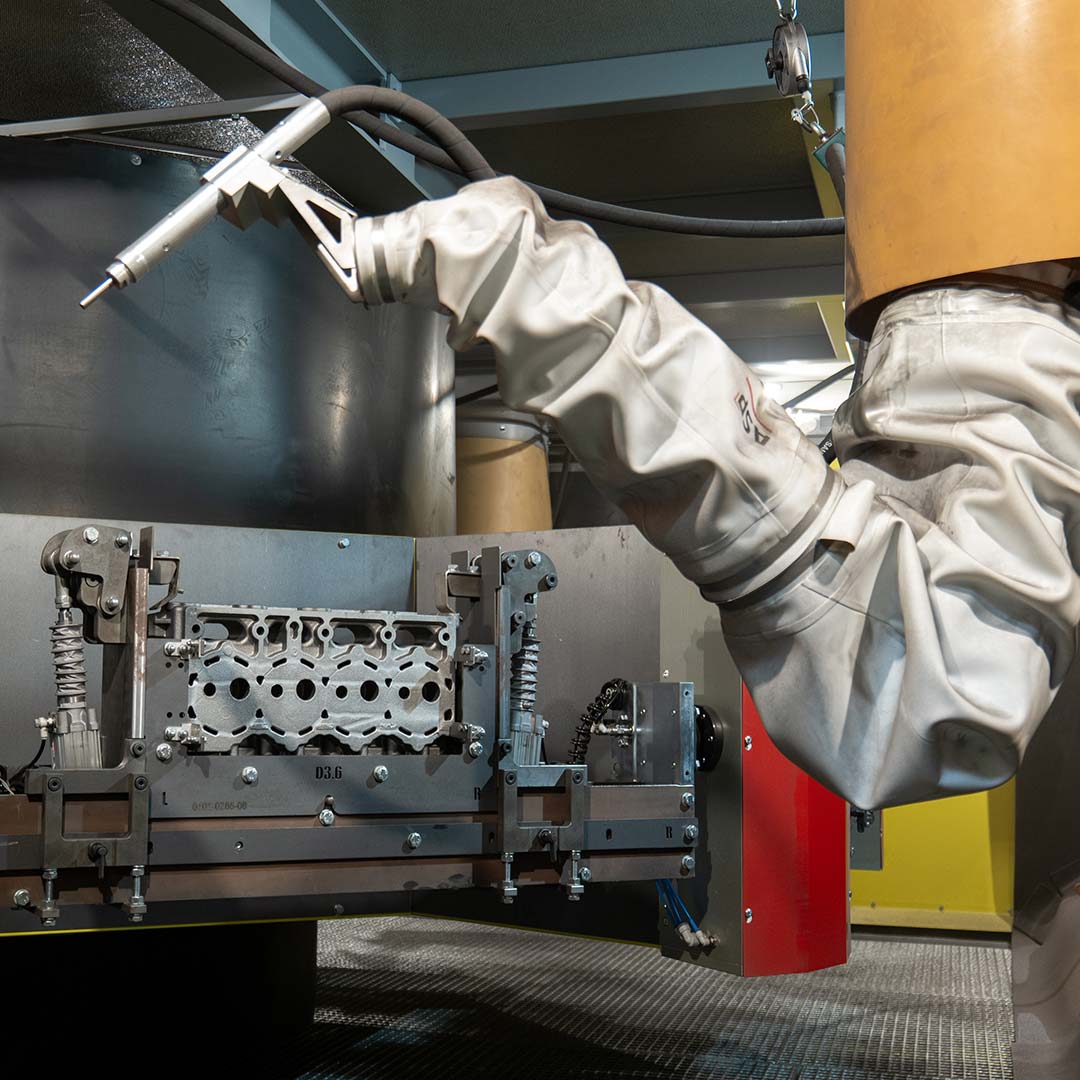
2. Robotic Internal Blasting: As the table indexes sequentially, the cylinder head passes through Stations 2, 3, 4, 5, 6, and 7, each with its own robotic blasting unit and nozzle. Each robot is programmed to focus on a different set of internal passages within the cylinder head, so that by the end of Station 7, all critical channels have been blasted clean. For example, one robot might clean exhaust ports while another focuses on oil galleries, and so on. The fixtures holding the part can automatically rotate 180° at each station, allowing the robots to access from the opposite side or flip the head as needed. Midway through, the system flips or re-orients the workpiece so that any passages that open on opposite sides of the head get equal attention. This combination of coordinated robots and part rotation ensures 360° coverage so every nook and cranny inside the casting is reached.
3. Blow-Off Cleaning: After the blasting stages, the table brings the part to Station 8, the final stage. Here, no abrasive is applied but instead, the cylinder head undergoes a high-pressure air blow-off. Powerful jets of compressed air are directed through all the passages to dislodge any remaining media or loose debris from the channels. This leaves the part essentially free of grit and dust.
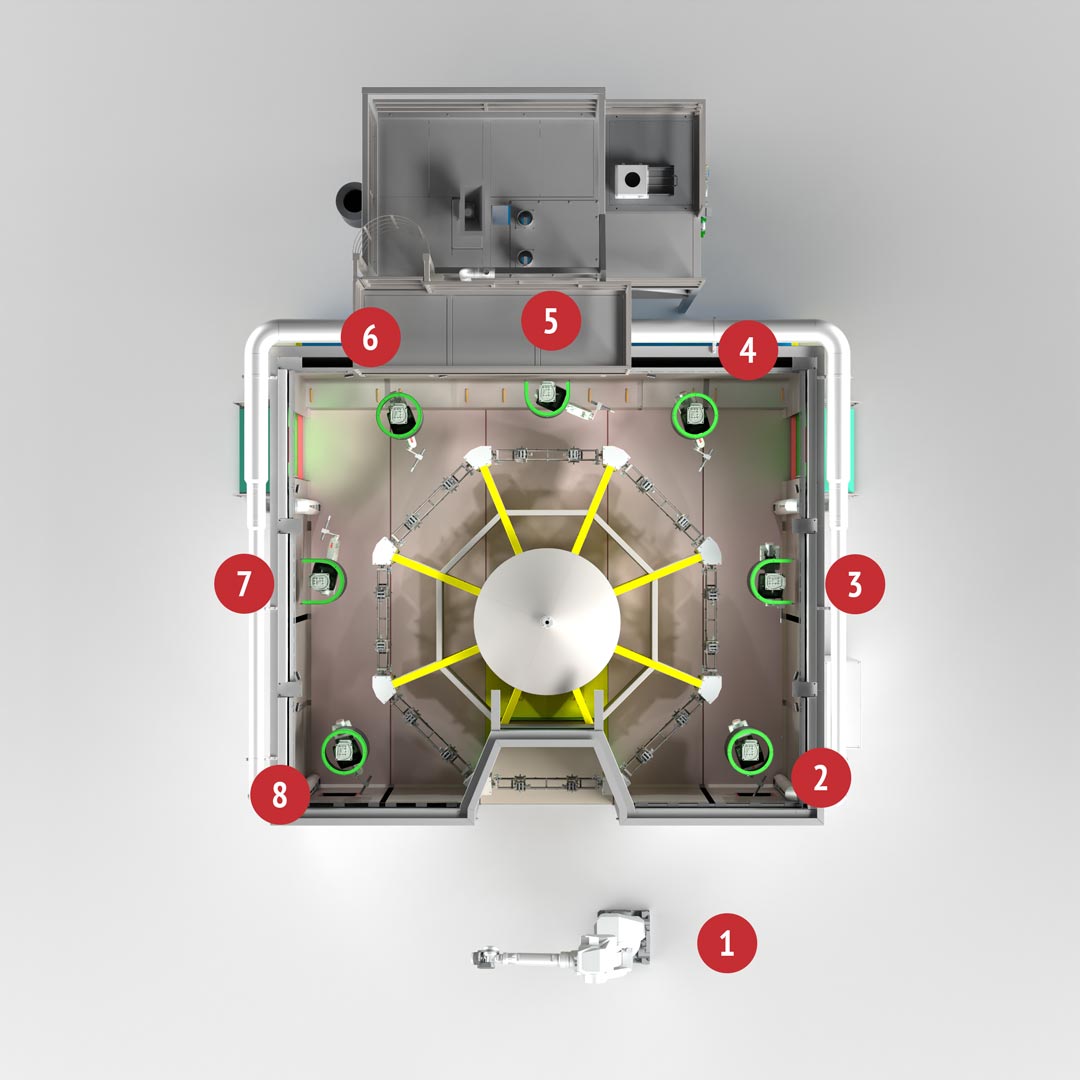
4. Unloading & Repeat: Finally, the table indexes back to Station 1 (which doubles as the unloading station in this configuration). The clean cylinder head is picked up by the loading robot (or an operator, if a robotic loader is not used) and removed from the machine. Immediately, a new raw part can be loaded in its place, and the cycle continues. The turntable indexing is synchronized such that while one part is being loaded/unloaded, other parts are simultaneously being blasted or cleaned at the other stations. This overlapping sequence means the machine achieves continuous production without idle time.
Importantly, we recognize that every foundry or manufacturing line is unique. That’s why our team works closely with each client to adapt the system to their specific parts and requirements. We conduct thorough testing with your sample parts, determining the optimal blasting media, pressure, and cycle parameters to achieve the desired cleanliness without any damage. Our expertise in abrasive media selection (considering factors like hardness, size, and shape) ensures you get the perfect balance of aggressiveness and gentleness for your particular alloy and casting geometry. The end result is a tailor-made recipe for your cylinder heads that is then stored in the machine’s FerroSmartPanel for one-touch recall whenever that part runs. This level of customization and process control simply isn’t feasible in manual operations.
Innovative Features Ensuring Consistent Cleaning
Delivering such a leap in performance is made possible by several key technological features built into this automated system. Together, these design elements solve the pain points of manual cleaning and guarantee repeatable, high-quality results:
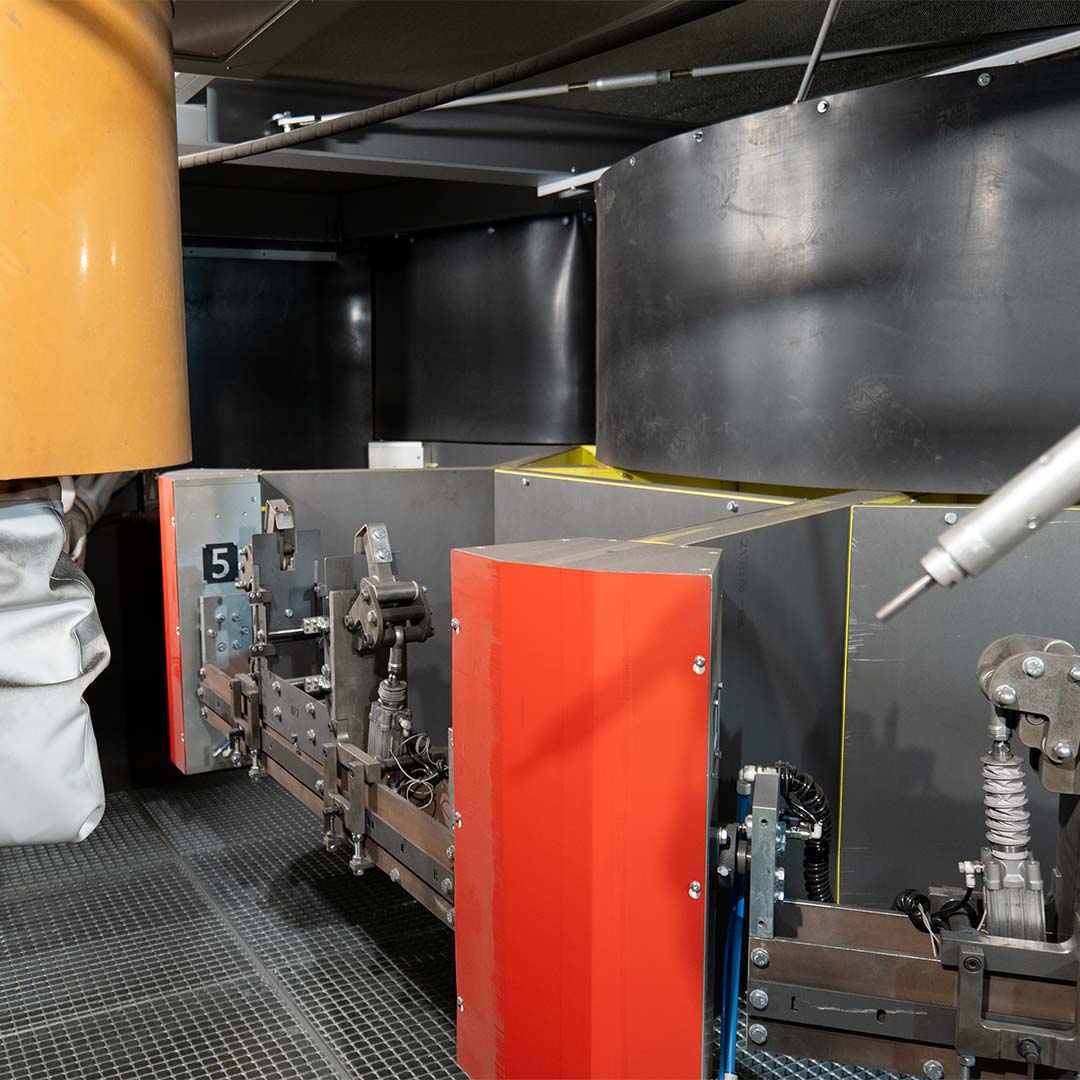
Multi-Robot Blasting System:The machine employs seven industrial 6-axis robotic manipulators, each equipped with a blast nozzle. These robots are strategically positioned around the indexing table to reach different internal areas of the cylinder head. They move with programmed precision, simulating the motions based on the hole. The coordinated robots and optional rotary lance attachments can navigate deep into passages, ensuring thorough cleaning of all internal surfaces. This robotic precision not only removes stubborn sand, rust, and scale, but also does so without accidentally missing spots or varying the intensity. |
|
|
Orbital Indexing Table with Rotating Fixtures:At the heart of the machine is a heavy-duty orbital indexing table with multiple stations. It acts like a carousel, moving parts from one operation to the next. Each station is fitted with a custom-designed fixture that securely holds the cylinder head in place. Importantly, these fixtures have an integrated 180° rotation mechanism. This means the part can be flipped or rotated side-to-side during blasting so that robots can access internal features from both sides of the casting. By the time a part has visited all blasting stations, it has literally been blasted from every angle.
The precision indexing ensures each station aligns perfectly, and a sensor system verifies that each part is correctly positioned and clamped before blasting begins (for safety and accuracy). The fixture design is also modular to accommodate different head models so operators can swap out fixture adapters when switching part types, a process that takes only about 15 minutes for a skilled operator. This flexibility allows one machine to handle multiple part designs with minimal changeover, which is ideal for manufacturers dealing with various engine models. |
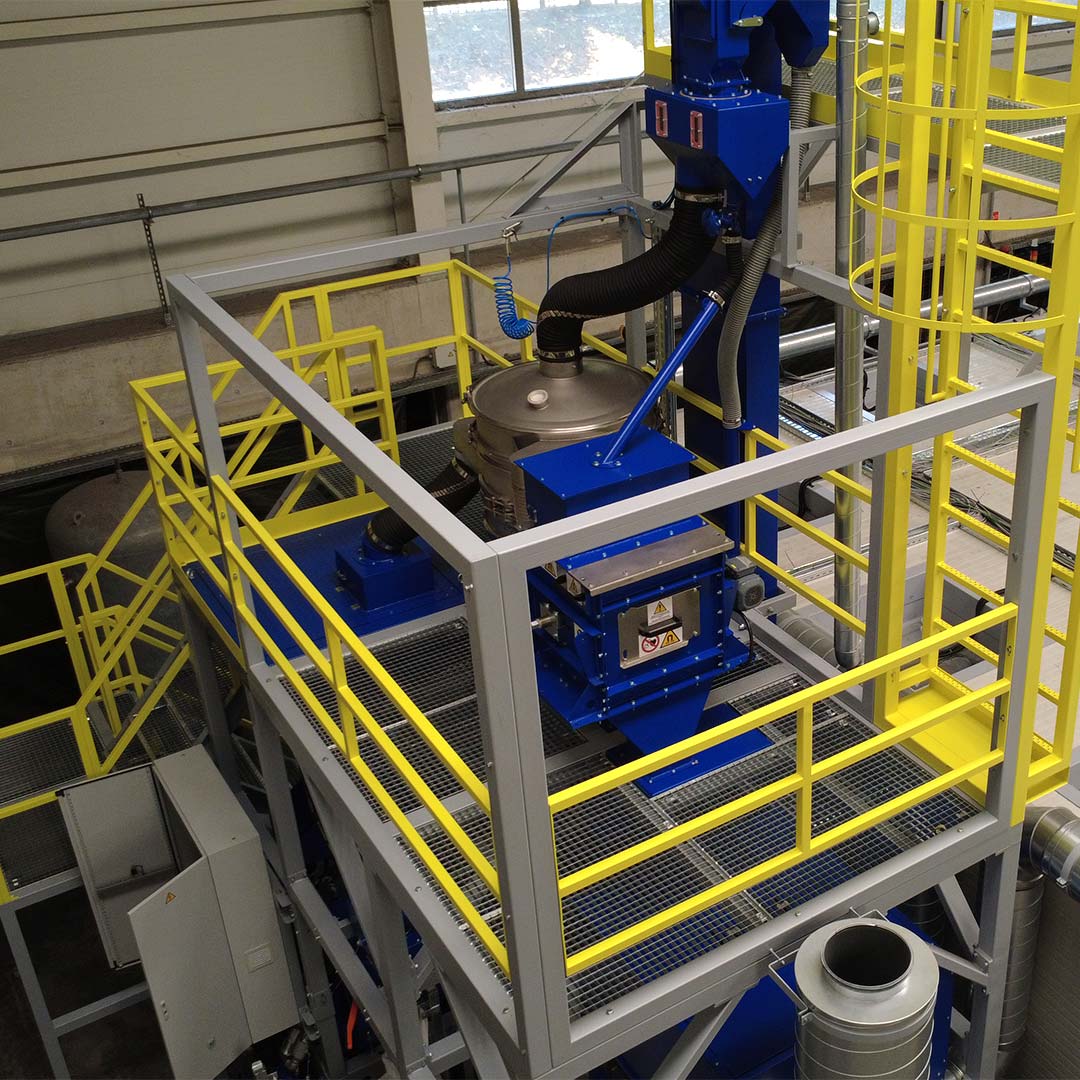
Advanced Media Recycling & Filtration:
|
 |
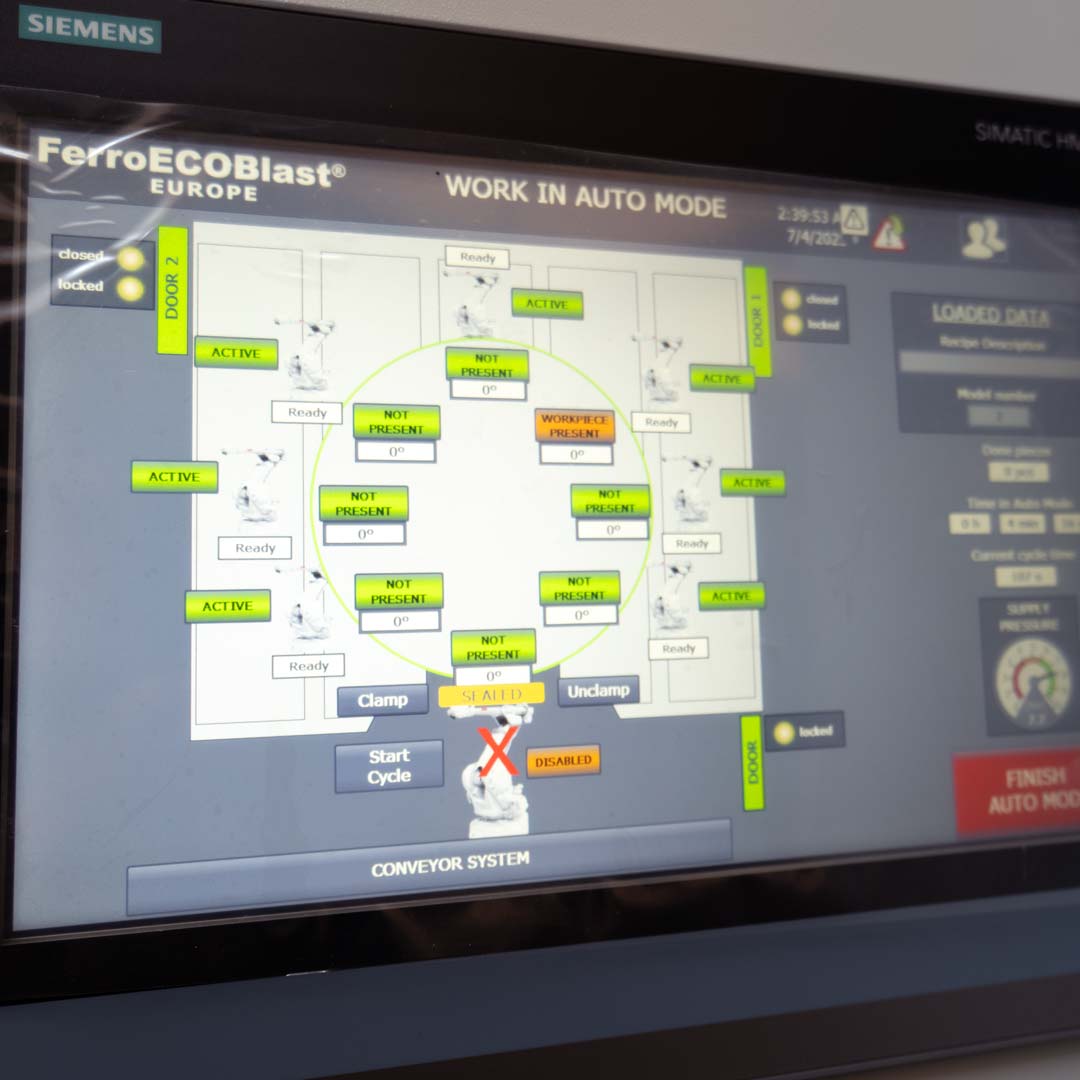 |
User-Friendly PLC Control:
|
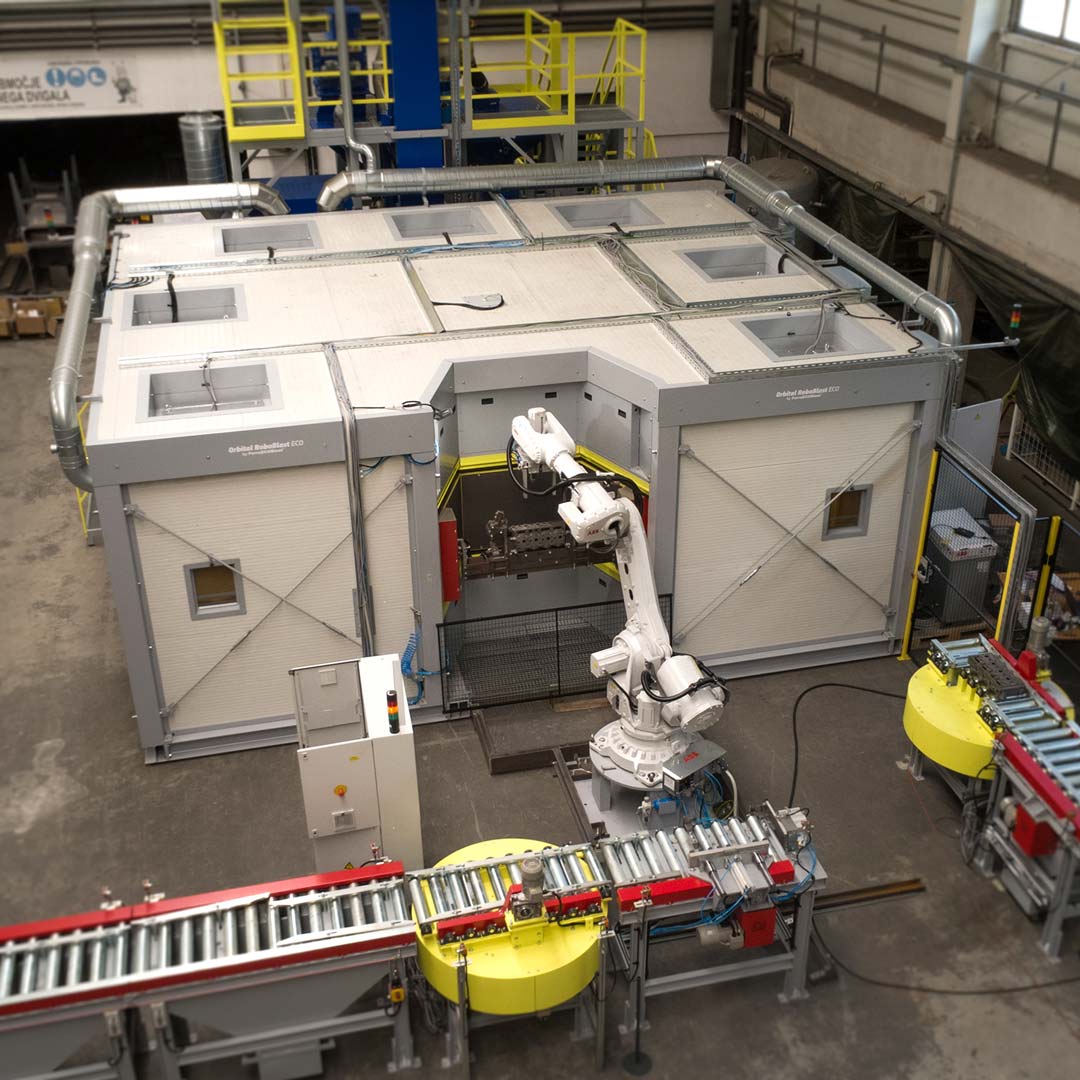
Heavy-Duty Build for Reliability:
|
 |
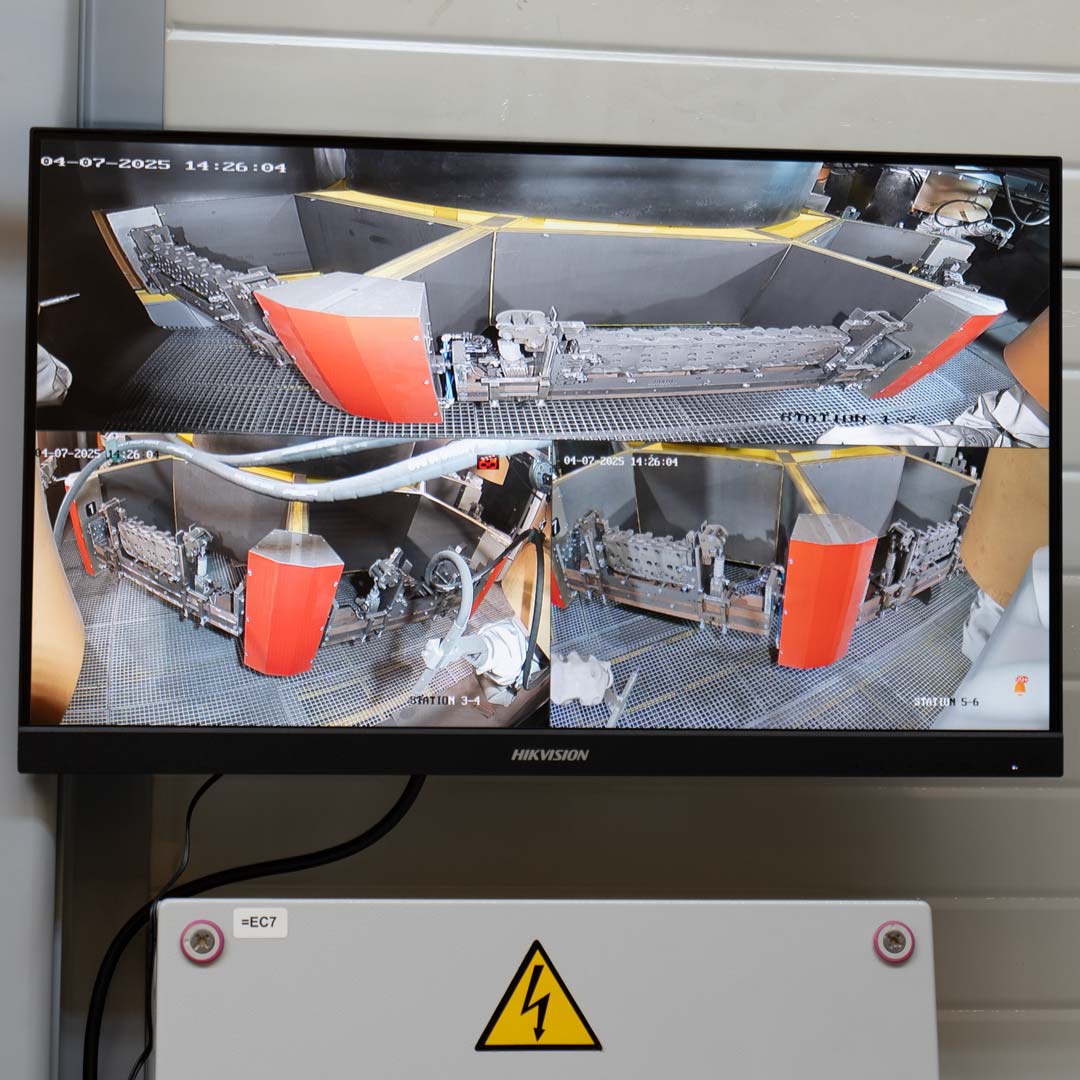 |
Safety and Ergonomics:
|
All these features work in harmony to ensure that each cylinder head is cleaned thoroughly, consistently, and efficiently. The machine essentially encapsulates decades of surface treatment expertise and best practices for example, we rigorously tested various abrasive media types, sizes, and hardness levels to find the optimal mix for this application. By fine-tuning parameters like blast pressure, nozzle geometry, and media flow (which are all digitally controlled), we achieved a process that cleans internal cavities effectively without damaging the base metal of the part. Every aspect, from the robotic motion paths to the media recycling loop, is engineered for repeatable quality and minimal downtime. The result is a state-of-the-art solution that addresses the root causes of the manual cleaning problem.
Benefits of Automating Cylinder Head Cleaning
Switching from manual blasting to an automated system delivers clear, measurable advantages. The most important is consistency. Each cylinder head is cleaned to the same high standard every time, with no risk of variation between operators or shifts. This ensures all internal passages are completely free of burned-on sand and debris, safeguarding engine performance and extending component life. Productivity is another major gain. What once took hours of tedious manual work can now be achieved in minutes. By running multiple parts in parallel, the machine eliminates bottlenecks and keeps production moving at a steady, predictable pace.
The system also reduces costs. Less labor is required, media is recycled continuously, and blasting parameters are optimized for efficiency, lowering both consumable use and energy consumption. Over time, this significantly decreases the cost per part. Perhaps just as important, automation improves working conditions. Operators are no longer exposed to dust, noise, and heavy manual blasting. Instead, they supervise a safe, enclosed process via a user-friendly control panel. This protects health, reduces strain, and allows skilled staff to focus on higher-value tasks. Finally, the Orbital Roboblast ECO is built for reliability, with rugged wear protection and smart maintenance features that keep uptime high. Combined with its closed-loop dust collection and recycling, it not only supports quality and throughput but also helps manufacturers meet stringent environmental and safety standards.
Embracing the Future of Cylinder Head Cleaning
The Orbital Roboblast ECO automated blasting system demonstrates that even the toughest, most ingrained manufacturing problems can be solved with smart engineering. By focusing on the problem (inconsistent and inefficient cleaning) and leveraging modern automation technology, we have created a solution that changes the game for engine component cleaning. It’s a new approach to surface preparation in the foundry industry.
By implementing this automated internal blasting solution, manufacturers can stay ahead of the curve. You are investing in advanced technology that boosts your productivity and quality today, while also future-proofing your operations for increasingly stringent quality demands. It’s a scalable solution, for example, additional machines can be added in parallel to double capacity, or the system can be integrated with upstream/downstream automation (conveyors, robotic handling) to create a fully automated production cell. In an industry moving toward Industry 4.0, having such automation in place also means you can collect valuable process data and integrate the blasting process into your digital factory systems for monitoring and traceability.
To learn more about our automated sandblasting solutions for engine components, you might explore our page on automated engine block cleaning solutions, which details how systems like OrbiBlockBlast ensure efficient cast sand removal.
If you’re ready to leave behind the hassles of manual cleaning and step into the future of automated surface treatment, our team at FerroECOBlast is here to help. Contact us to discuss your specific needs and find out how the Orbital Roboblast ECO or a custom-engineered solution could transform your production process. With over 60 years of experience in surface finishing, we have the know-how to tackle your toughest cleaning problems and tailor a solution that delivers results. The era of burned-on sand headaches is over. An era of smart, automated cleaning is here.