Why Choose Laser Cleaning?
Laser Cleaning is becoming the superior option for modern cleaning, texturing, or marking needs and presents excellent advantages over standard techniques with:
- High precision and consistency: In any given laser treatment, high accuracy and repeatability ensure that every part of the surface being processed is uniform.
- Automation and Efficiency: Our systems provide programmable laser mode operation and reduce manual labor, enabling optimization of process cycles and improving productivity.
- Improved safety and environmental benefits: Lasers work cleanly by continually suctioning and filtering gases and toxic fumes, improving the working environment by reducing the ecological impact.
 |
|
|
|
|
| Cleaning
Precisely removes rust, paint, and oxides, ensuring surface integrity. |
Texturing
Adjusts surface roughness to enhance adhesion and functionality. |
Marking
Permanently marks parts with barcodes and logos for easy tracking and compliance. |
Optimized Process Speed
Accelerates production cycles with quick, repeatable laser operations. |
Reduced Environmental Impact
Minimizes waste and avoids the use of chemicals, supporting a cleaner production environment. |
Laser Cleaning Products
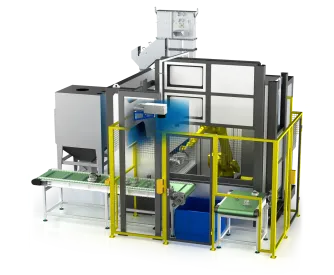
Laser RoboBlast system - Robotic Laser Cleaning
Robotic laser cleaning system designed for precise and efficient cleaning of various components.
Laser Cleaning Solution
In industries where partial coating removal is encountered, laser precision saves a huge amount of time over unattractive and time-consuming manual masking, which, moreover, can never be done with 'laser' precision.
Using a pulsed laser, laser cleaning can replace traditional methods of removing rust, oxide, paint, and other contaminants from metal surfaces. Emerging applications include weld cleaning, mold cleaning, tool cleaning, and surface preparation. While abrasive blasting media and other cleaning tools may damage the surface, a laser beam removes contaminants with unmatched consistency without introducing impurities in the base material or damaging it.
Laser cleaning is the newest, fastest, most efficient and environmentally conscious method of removing rust, oxides, paint, cleaning welds and other impurities from the surfaces of (mainly) metal and other compatible materials. Using laser technology, we can also roughen the surfaces before applying paints, adhesives, and other coatings.
Cleaning example: rust, oxide removal, or selective paint striping - before adhesive bonding, laser texturing can be used to obtain robust and predictable bonds without causing surface defects.


Laser surface texturing can be used to improve properties like adherence, wettability, electrical and thermal conductivity, and friction.
Same as abrasive blasting or chemical etching, laser surface texturing can be used to improve properties like adherence, wettability, electrical and thermal conductivity, and friction. For example, you can increase surface adherence before applying common coatings like adhesives, paint, etc. Laser texturing can also be used to prepare surfaces for thermal spray coating and laser cladding as well as to improve the performance of mechanical seals.
Texturing example: increase surface adherence before applying common coatings like adhesives, paint, or ceramic. Different labels and tags aren’t permanent – they can fall off or be erased during the surface treatments.


Laser marking has become the technology of choice for manufacturers looking for high-quality marking, offering a multitude of advantages compared to older marking methods like dot peen marking, inkjet printing, and printed labels.
Laser marking is the process of permanently (Post-treatment resistance if needed) marking a surface using a focused beam of light. It is often used to identify parts and products with 2D barcodes (data matrix codes or QR codes), alphanumerical serial numbers, VIN numbers, and logos.
Marking example: part & product traceability - etching and engraving QR codes, barcodes, serial numbers, etc.